

PREFACE
It is rather common for most people to assume the worst when look at the liver function test on your bloodwork results…
You do a quick Google search on your ‘out of range’ liver values and are returned with a laundry list of potential possible life-threatening causes.
So, before jumping to any concrete conclusions, I strongly urge you to read this post start to finish as the following information will help you better understand the commonly elevated and controversial markers when getting your routine bloodwork done.
However before we begin just to put it out there that if you:
- are a health-conscious individual / not obese
- eat a balanced diet
- get 7-9 hours of sleep on average
- do some form of resistance training and cardiovascular training on a regular basis
then despite what your liver values might say, it is HIGHLY unlikely that you have anything to be alarmed about (even if your doctor appears concerned) and now it is time to explain why that is…
So what is a liver function test (LFT)?
A LFT, also known as a: hepatic function panel, is a blood test that measures a handful of substances produced by the liver. This consists of a range of: enzymes, proteins and other acids such as bile (which plays a crucial role in the digestion process).
Now the exact values tested might vary from region to region (depending on your locale) although they typically measure a handful (if not, all) of the following values:
- Albumin – a transporter protein, sometimes binding to steroid hormones (i.e. albumin-bound testosterone).
- Total (net) protein – in the blood at the time of testing.
- ALP (alkaline phosphatase) – an enzyme
- ALT (alanine transaminase) – an enzyme
- AST (aspartate aminotransferase) – an enzyme
- Gamma-glutamyl tansferase (GGT) – an enzyme
- Bilirubin – a liver waste product.
- Lactate Dehydrogenase (LD) – an enzyme
- Prothrombin time (PT) – a blood clotting protein.
There chances are that if you have notices any liver values out of range on your blood test and are a healthy individual by most standards, then the values that are likely going to be ‘out’ on your LFT panel are going to be one, two, or all of the following:
- ALT
- AST
- LD
ALT, AST & LD…
Alanine aminotranferease (ALT) and aspartate aminotransferase (AST) are enzymes located in the liver cells that leak out into the general circulation when liver cells are injured. These two enzymes were previously known as the SGPT (serum glutamic-pyruvic transaminase) and the SGOT (serum glutaic-oxaloacetic transaminase). These two transaminase enzymes may be reported on lab slips with both their new names and previous names or by their new names only. ALT and AST are present in highest concentrations in cells from the liver, heart, skeletal muscles, and red blood cells. Patients whose LFTs show a predominant rise in the transaminases (3-10 times upper limit of normal) may have liver diseases (mild – severe) that are characterized by hepatocellular damage.
ALT is found predominately in the liver, with lesser quantities found in the kidneys, heart, and skeletal muscle. As a result, the ALT is a more specific indicator of liver inflammation than the AST. As the AST may also be elevated in diseases that affect other organs, such as the heart or the muscles, AST is also elevated after a myocardial infarction, and during acute pancreatitis, acute hemolytic anemia, severe burns, acute renal disease, musculoskeletal diseases, and trauma.
LD is another enzyme found in the liver and although it is less exclusive to the live; being that it is found in most cells throughout the body, it is released into the blood when cells have been damaged by disease or injury (tissue trauma).
TRAUMA & INFECTION
As previously mentioned; the two more common catalysts for elevations in these specific values are:
- Trauma
- Infection
Now, the trauma which could potentiate the release of these enzymes into the blood stream include: muscle damage caused in the gym by lifting weights, cuts and even things like: intramuscular (IM) injections
It is for this reason that, weight training, IM injections and any other strenuous activities should be avoided for at least 48 hours prior to a LFT to help improve the accuracy of the values reflected in your LFT panel.
However if an IM injection must be given close to the time blood is drawn for a LFT, then the patient should disclose that with the doctor or if it was administered by a registered nurse, then it can be noted on the lab slip (the time that the injection was given) to ensure there is no unwarranted panic when the results have been returned.
Now, if there were no injections given in the lead up to the LFT, then there could be legitimate cause for concern as this might indicate a bacterial or viral infection of some sort… that can be anything from viruses like the common cold, the flu, the EBV (Epstein-Barr Virus), to infections like those that occur as a result of non-sterile IM injections, unclean wounds etc.
MEDICATIONS
Many liver enzyme tests are also affected by medications (statins being one of the well documented types of medication to have this effect).
It is important to consult the laboratory manual for medications that should be considered in the interpretation of test results, and to indicate such medications on the lab slip.
ALT is a more specific indicator of liver inflammation than the AST. The normal range of ALT levels is between 5 IU/L to 60 IU/L (International Units per Liter). The normal range for AST levels in the bloodstream are 5 IU/L to 43 IU/L. Warnings for statin and ezetimibe use state that 3 times upper limit of normal (around 150 IU/L) is where most doctors would consider withdrawing therapy. Intermittent raises of LFT’s are not automatically associated with any disease or damage, but may indicate issues with drug metabolism or dietary imbalances.
Creatine Kinase (CK, CPK) is an enzyme found primarily in the heart and skeletal muscles, and to a lesser extent in the brain. Significant injury to any of these structures will lead to a measurable increase in CK levels. When the CPK level is substantially elevated, it usually indicates injury (e.g. Myositis). A simple blood test can measure levels of creatine phosphokinase. A value of between 25 IU/L and 200 IU/L would be regarded as normal, but levels can escalate into the thousands. A myositis ‘flare’ is often diagnosed by a sharp increase in CK or CPK values.
Elevations are found in:
Myocardial infarction.
Crushing muscular trauma.
Any cardiac or muscle disease, but not myesthenia gravis or multiple sclerosis.
Brain injury.
Hypothyroidism.
Hypokalemia.
Once elevated, CK remains elevated for several days, if the injury is acute.
If there is on-going injury, the CK will remain elevated indefinitely.
High serum CK levels can indicate muscle damage due to chronic disease or acute muscle injury (fatigue through training, playing football or cycling etc). For this reason, if you’re scheduled to have blood drawn for a CK test to diagnose a potential muscle disorder, you should limit your exercise to normal activities for several days before the test.
Moderate-intensity exercise (maintaining heart rate between 55% and 90% of maximum) may elevate creatine kinase (CK) to levels that meet the diagnostic criteria for rhabdomyolysis if the exercises involve eccentric muscle contractions, such as weight lifting or HIIT running. It is not unusual for athletes to have levels above 2,000 IU/L and as high as 20,000IU/L without any accompanying decrease in renal function.
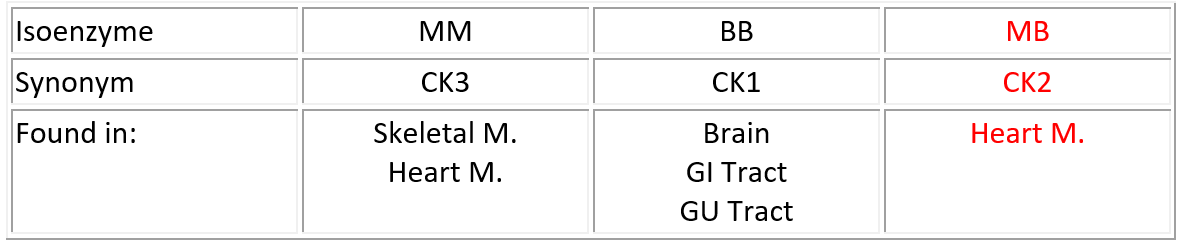
CK/CPK Isoenzymes
There are three Isoenzymes. Measuring them is of value in the presence of elevated levels of CK or CKP to determine the source of the elevation.
Normal levels of CK/CPK are almost entirely MM, from skeletal muscle.
Elevated levels of CK/CPK resulting from acute myocardial infarction are about half MM and half MB
Normal Values for CK, CPK*

Normal Values for CK or CPK Isoenzymes*

*These are general values taken from a variety of sources. The actual normal values may vary from lab to lab and from one type of testing protocol to another.